In this comprehensive tutorial, we’ll explore how Laravel’s Eloquent ORM makes handling database relationships easy and powerful. From one-to-one associations to many-to-many connections, you’ll learn step by step how to define, query, and manage relationships with real-world examples.
Databases are the backbone of most modern applications, and relationships between tables are what make them powerful. Laravel’s Eloquent ORM (Object-Relational Mapper) provides a clean, expressive syntax to define and query these relationships. Instead of writing complex SQL joins, you can interact with related models naturally using Eloquent’s methods.
In this guide, we will cover the three most commonly used relationships:
Eloquent provides helper methods to define relationships directly within models. These methods include:
Method
Relationship
hasOne
One-to-One
hasMany
One-to-Many
belongsTo
Inverse of One-to-One / One-to-Many
belongsToMany
Many-to-Many
One-to-One Relationship
A one-to-one relationship means that a record in one table is associated with exactly one record in another table. For example, a User has one Profile.
Step 1: Create Migrations
php artisan make:model User -m
php artisan make:model Profile -m
// app/Models/User.php
public function profile()
{
    return $this->hasOne(Profile::class);
}

// app/Models/Profile.php
public function user()
{
    return $this->belongsTo(User::class);
}
Step 3: Using the Relationship
// Create a user and profile
$user = User::create(['name' => 'Alice', 'email' => 'alice@example.com']);
$user->profile()->create(['phone' => '1234567890', 'bio' => 'Web Developer']);

// Accessing profile
$profile = $user->profile;

// Accessing user from profile
$user = Profile::find(1)->user;
One-to-Many Relationship
A one-to-many relationship means one record in a table can be associated with multiple records in another. Example: a Post can have many Comments.
Step 1: Create Models and Migrations
php artisan make:model Post -m
php artisan make:model Comment -m
// app/Models/Post.php
public function comments()
{
    return $this->hasMany(Comment::class);
}

// app/Models/Comment.php
public function post()
{
    return $this->belongsTo(Post::class);
}
Step 3: Using the Relationship
// Create a post and comments
$post = Post::create(['title' => 'My First Post', 'content' => 'Hello World!']);
$post->comments()->create(['author' => 'Bob', 'comment' => 'Great post!']);
$post->comments()->create(['author' => 'Jane', 'comment' => 'Thanks for sharing!']);

// Access comments
foreach ($post->comments as $comment) {
    echo $comment->author . ': ' . $comment->comment;
}

// Get post from a comment
$comment = Comment::find(1);
echo $comment->post->title;
Many-to-Many Relationship
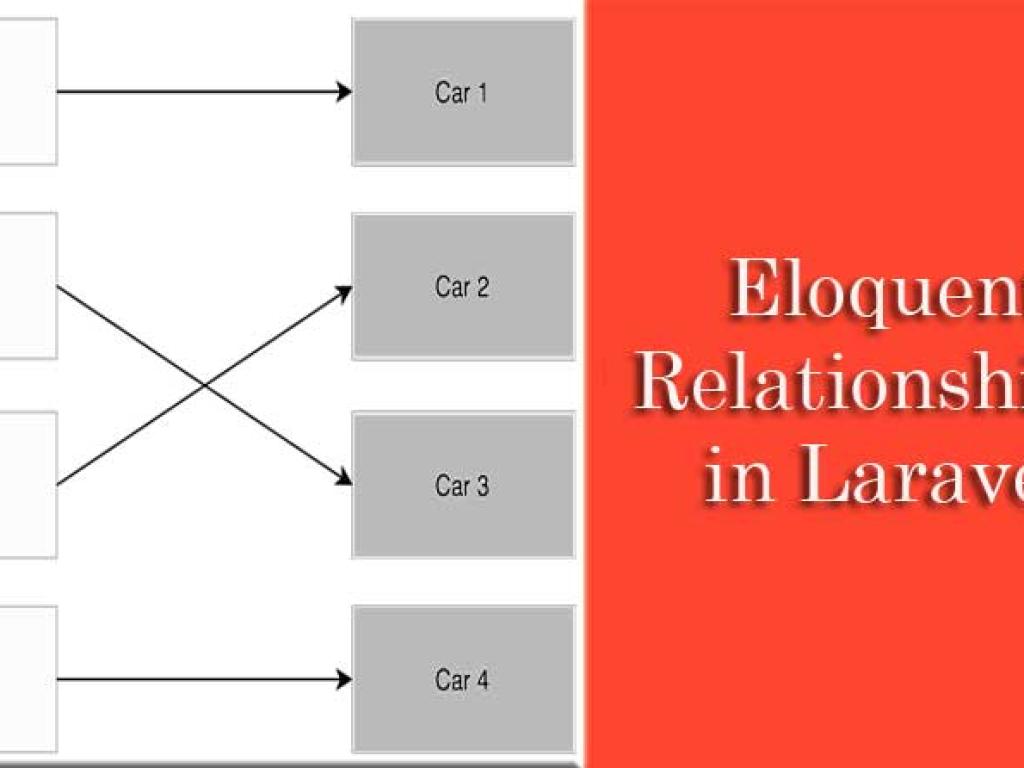
A many-to-many relationship means multiple records in one table are related to multiple records in another. Example: a Student can enroll in many Courses, and a Course can have many Students.
// app/Models/Student.php
public function courses()
{
    return $this->belongsToMany(Course::class);
}

// app/Models/Course.php
public function students()
{
    return $this->belongsToMany(Student::class);
}
Step 3: Using the Relationship
// Attach students to courses
$student = Student::create(['name' => 'Emma']);
$course1 = Course::create(['title' => 'Math 101']);
$course2 = Course::create(['title' => 'Science 101']);

$student->courses()->attach([$course1->id, $course2->id]);

// Retrieve student's courses
foreach ($student->courses as $course) {
    echo $course->title;
}

// Retrieve course's students
foreach ($course1->students as $student) {
    echo $student->name;
}
Pivot Tables and Extra Fields
In many-to-many relationships, the pivot table can store additional data such as enrollment date.
// Accessing pivot data
foreach ($student->courses as $course) {
    echo $course->pivot->enrolled_at;
}
Eager Loading Relationships
To avoid the N+1 query problem, use eager loading:
$posts = Post::with('comments')->get();
Best Practices
Always name pivot tables using singular model names in alphabetical order (e.g., course_student).
Use eager loading for efficiency when retrieving relationships.
Leverage Laravel factories and seeders for testing relationships.
Keep relationship logic inside models for clarity.
Conclusion
Laravel’s Eloquent ORM makes working with relationships intuitive and elegant. By mastering one-to-one, one-to-many, and many-to-many relationships, you unlock the full potential of relational databases. Whether building user profiles, blog systems, or course enrollments, Eloquent provides the tools to structure your application’s data effectively.
In real-world applications, you’ll often combine these relationships, and Laravel makes it seamless to work with even the most complex database structures. With the knowledge gained here, you’re now equipped to design clean and scalable database relationships in your Laravel projects.
This article is a comprehensive tutorial on using the Prohibited Validation Rules in Laravel. You will learn how to apply prohibited, prohibited_if, and prohibited_unless with clear explanations, real-life scenarios, and code examples. This guide is perfect for developers who want to master advanced validation techniques in Laravel applications.
This detailed tutorial explores request validation in Laravel controllers. You’ll learn multiple techniques—basic controller validation, using form request classes, custom rules, conditional validation, error handling, localization, and best practices. With practical examples, code snippets, and structured explanations, this article is designed for beginners to advance learner.
This guide teaches you how to deploy Laravel applications to production servers. From preparing your environment and configuring Nginx or Apache, to database migrations, caching, performance optimization, CI/CD pipelines, and security practices—this article covers everything step by step.It’s suitable for both beginners and advanced developers who want to ship stable, secure & scalable app.
This website uses cookies to enhance your browsing experience. By continuing to use this site, you consent to the use of cookies. Please review our Privacy Policy for more information on how we handle your data. Cookie Policy
These cookies are essential for the website to function properly.
These cookies help us understand how visitors interact with the website.
These cookies are used to deliver personalized advertisements.