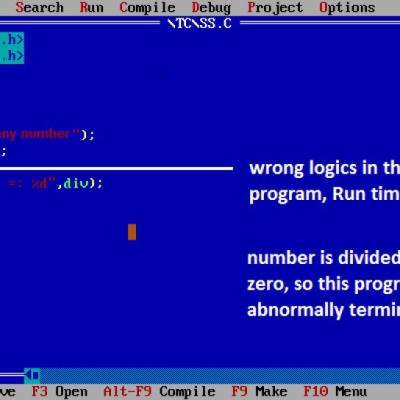

Error Handling in C
Ensure robust C programs — learn error detection with return codes, errno, perror/strerror, assertions, memory and file I/O error handling with clear examples.


Ensure robust C programs — learn error detection with return codes, errno, perror/strerror, assertions, memory and file I/O error handling with clear examples.
Unlock flexibility in C—learn how to implement variadic functions using stdarg.h: handling ellipses (...), va_list, va_start, va_arg, va_end, with clear examples.
Read MoreUnlock the power of C preprocessors — learn directives like #include, #define, macros, conditional compilation, and file inclusion for cleaner, flexible code.
Read MoreLeverage C command-line arguments—learn argc, argv[], parsing techniques, optional envp, data conversion, and flag handling with practical code examples.
Read MoreConquer recursion in C: define recursive functions, master base and recursive cases, explore factorial, Fibonacci, tree traversal, and understand stack behavior.
Read MoreTake charge of memory in C — master static vs dynamic allocation, heap vs stack, malloc/calloc/realloc/free, and avoid leaks with practical examples.
Read MoreControl C data conversion with type casting — understand implicit vs explicit casting, using (type) syntax, built-in conversion functions, and precision rules.
Read MoreMaster C input/output essentials — learn how to use printf, scanf, getchar, putchar, and format specifiers to handle user data with clear examples.
Read MoreSimplify your C code with typedef — learn how to alias types, including structs, pointers, arrays, and function pointers for cleaner, more readable declarations.
Read MoreOptimize memory with C bit-fields — learn how to declare fixed-width struct members, use unnamed and zero-width fields for alignment, and pack data efficiently.
Read MoreMaster file I/O in C — learn to open, read, write, seek, and close files for text and binary using FILE pointers and standard library functions.
Read MoreUnlock memory-efficient coding in C—learn to define unions, manage shared member storage, compare with structs, and use unions for flexible type handling.
Read More